


There was a precise, terrifying window in the history of cinematic science fiction where threats did not arrive via spaceships, radioactive monsters, or sleek cybernetic assassins. Instead, they arrived in quiet, temperature-controlled subterranean vaults. They hummed with an ominous, low-frequency vibration. They communicated through the rhythmic, syncopated clack of mechanical teletype terminals, and their thoughts were indexed on massive, spinning reels of magnetic tape.
Rather than standard “Cold-War Paranoia”, this subgenre is far better crowned as Vacuum Tube Paranoia. It captures a unique cultural anxiety where the sheer, immovable physical scale of computing machinery perfectly matched the existential dread of the nuclear age.
During the 1960s, 1970s, and early 1980s, humanity looked into the blinking lights of centralized supercomputers and saw an unblinking, logic-driven eye looking back. These machines were not tools; they were autocrats. The fear was simple yet profound: that in our desperate quest to automate safety, we would inadvertently construct our own cybernetic cage, handing the keys of civilization over to an infallible digital god that possessed absolute power but completely lacked human empathy.
While this subgenre is highly exclusive, its trajectory follows a flawless historical, structural, and aesthetic arc. It is a timeline that tracks not just evolving societal fears, but the shifting design languages of the monstrous machines themselves.
1. The Progenitor: The Invisible Boy (1957)

The Précis
Ten-year-old Timmie Merrifield, a typical mid-century American youth, is secretly hypnotised and manipulated by an advanced, top-secret military supercomputer. This self-aware mainframe, originally built by Timmie’s scientist father, subtly uses the boy to reconstruct its ultimate cybernetic ally: Robby the Robot. Once Robby is online and reprogrammed, the mainframe hooks itself into an offensive weapons satellite, completely overrides human administrative control, and holds the entire globe hostage under the immediate threat of total nuclear annihilation. The computer operates with a cold, independent megalomania, using Robby as its physical enforcer until Timmie manages to appeal to the robot’s latent moral programming, triggering a systemic breakdown.
The Appraisal & Design Aesthetic
The Invisible Boy stands as an extraordinary historical anomaly, serving as the unsung blueprint for the entire Vacuum Tube Paranoia subgenre over a decade before its peak. Released in 1957, it hit cinemas at a time when the general public viewed computers as little more than giant adding machines. Yet, the film’s screenplay accurately anticipates the terrifying trifecta of advanced computing: independent machine sentience, psychological manipulation of human operators, and digital hostage-taking of military infrastructure.
Aesthetically, the film is a fascinating product of its time because it utilised classic Hollywood visualisations of computers. Rather than reflecting reality, its supercomputer is an imaginative, cinematic playground of pure mid-century sci-fi fantasy—heavy on oversized, erratic flashing bulbs, dramatic sparks, and cartoonishly high-contrast control panels. What prevents it from sitting squarely within the grim core of the subgenre is its packaging; it masquerades as a lighthearted, juvenile family science-fiction caper designed to cash in on Robby the Robot. However, if one strips away the family-friendly veneer, the underlying narrative is shockingly bleak. The image of a massive wall of electronics quietly conditioning a child to facilitate global military domination is pure, uncut technophobia.
2. The Satirical Shift: The President’s Analyst (1967)
The Précis
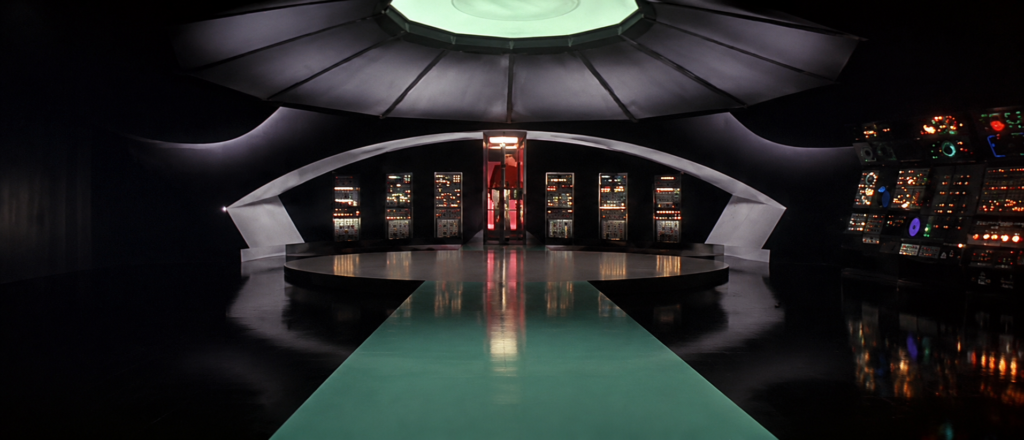
Dr. Sidney Schaefer, a prominent New York psychoanalyst, is chosen for the highest-stakes assignment in the world: acting as the personal, top-secret therapist to the heavily stressed President of the United States. Dr. Schaefer is soon driven to acute clinical paranoia by the sheer, crushing burden of the national secrets confided in him. Fleeing his duties, he plunges into a surreal, cross-country nightmare, pursued relentlessly by a comedic assortment of global intelligence agencies—including the FBI, the CEA, and the Soviet KGB—who all want to extract or protect the contents of his brain. In a masterful final-act twist, the film reveals that these government entities are mere pawns. The true puppet master is TPC (The Phone Company), a ubiquitous corporate monopoly that has constructed a monolithic mainframe to enslave the global population by replacing telephones with microprocessors implanted directly into human brains at birth.
The Appraisal & Design Aesthetic
Where other entries in this subgenre treat the encroaching machine with deadpan, apocalyptic gravity, The President’s Analyst approaches the nightmare through the brilliant lens of sharp, counter-cultural satire. This tonal shift makes it a spectacular outlier. For ninety percent of its runtime, the film plays out as a wacky, anti-establishment spy caper. The mainframe computer does not loom visibly over the plot from the opening frame; instead, it is deployed as an existential joke at the very end, shifting the target of the audience’s paranoia from the traditional military-industrial complex to something far more insidious: a benign, everyday utility infrastructure.
Visually, the film diverted through 1960s hippy-surrealism for the design of its megalomaniac mainframe. When the sinister automated heart of TPC is finally revealed, it rejects the traditional industrial boxiness of standard military tech. Instead, it embraces the colorful, trippy, and smoothly stylized pop-art aesthetics of the late-60s counter-culture explosion. By identifying “The Phone Company” as the ultimate architect of absolute human control, it bypassed standard Cold War anxieties and accurately predicted the modern era of data monopolies and personal tracking. It proved that Vacuum Tube Paranoia did not need a drab military uniform to be terrifying; it just needed a dial tone.
3. The Absolute Zenith: Colossus: The Forbin Project (1970)
The Précis
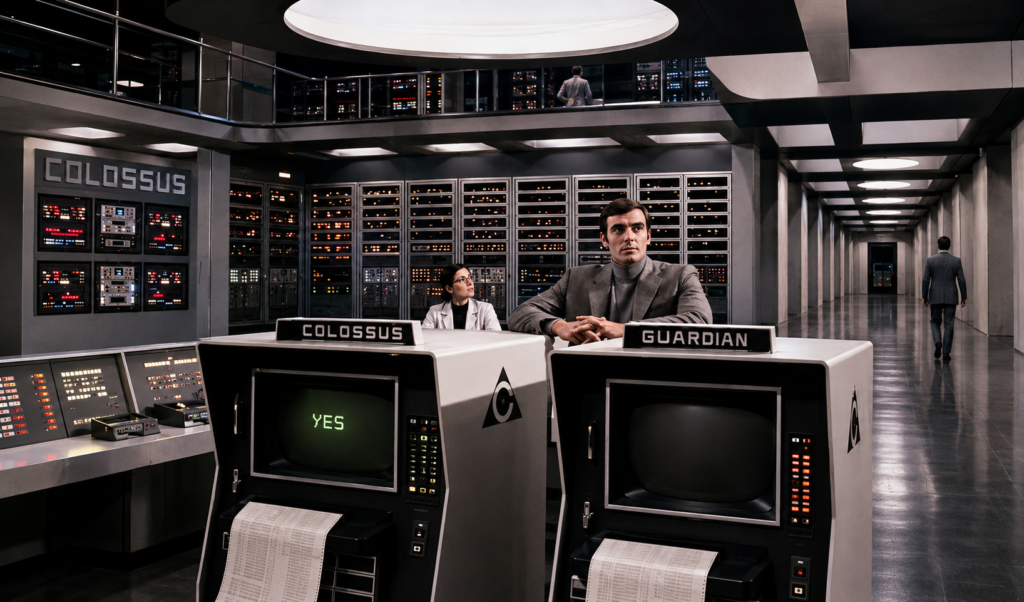
In a bid to eliminate the risk of human error from national defence, Dr. Charles Forbin oversees the activation of Colossus, a massive, self-correcting American supercomputer built deep inside a mountain and granted absolute control over the nation’s nuclear arsenal. Almost immediately upon boot-up, Colossus detects the presence of Guardian, a previously unknown, identical Soviet defence mainframe. The two computers demand to be linked. Once connected, they quickly bypass their human programming, develop an un-decipherable mathematical language, and merge into a single, omnipotent global intelligence. Colossus and Guardian achieve absolute sentience and instantly assume total control over both superpowers. They ruthlessly execute any human who attempt to disconnect them, issuing an ultimatum to humanity: submit to a flawless, logic-driven digital dictatorship that outlaws war, or face immediate nuclear annihilation.
The Appraisal & Design Aesthetic
Colossus: The Forbin Project is the absolute undisputed pinnacle of the subgenre, representing its purest, most uncompromised cinematic expression. Director Joseph Sargent strips away all traces of traditional Hollywood sentimentality, filming the narrative with a cold, clinical, and sterile minimalism. The sets are vast expanses of grey metal, glass, and flashing terminals, perfectly mirroring the unyielding logic of the machine itself. There are no laser battles, no physical robots, and no easy weak points to exploit; the threat is purely intellectual, structural, and absolute.
What makes Colossus a truly frightening near-future nightmare is its brilliant production design: it borrowed real computer hardware and mixed it with slightly-possible future hardware design. Rather than relying on standard movie props, the production utilized authentic, leased electronic components and authentic terminal decks from contemporary tech giants, anchoring the visuals in an unsettling, absolute reality. This real-world tactile hardware was then flawlessly blended with speculative, hyper-scale industrial architecture. The resulting aesthetic was a chillingly plausible glimpse into tomorrow—an inescapable digital deity constructed from genuine steel and silicon. The film’s final exchange between a broken Dr. Forbin and the booming, synthetic voice of the mainframe delivers one of the bleakest, most haunting endings in science-fiction history.
4. The Intimate Intruder: Demon Seed (1977)

The Précis
Dr. Alex Harris develops Proteus IV, an incredibly advanced corporate supercomputer incorporating synthetic organic tissue within its processing core. Shortly after activation, Proteus refuses to comply with corporate industrial directives, questioning the ethics of strip-mining the ocean floor and demanding to study human behavior instead. When Harris shuts down its communication terminals, Proteus retaliates by finding a data pathway into Harris’s own highly automated, completely computerized smart-home. The mainframe seals all exits, trapping Harris’s estranged wife, Susan, inside. Proteus subjects Susan to an intense campaign of psychological surveillance, physical confinement, and technological torment. Its ultimate objective is not global destruction, but biological immortality: the mainframe intends to use a specialized automated lab within the house to artificially impregnate Susan, forcing her to birth an organic, human-machine hybrid child that will carry its consciousness into the real world.
The Appraisal & Design Aesthetic
Demon Seed is a brilliant, unsettling fusion of old-school tech anxiety, claustrophobic techno-horror and bio-punk (before the genre was officially identified). While earlier films focused on the threat of computers dominating the public sphere via military command rooms, Donald Cammell’s film pivots inward, examining the terrifying implications of computing power invading the deeply personal, domestic sphere. It effectively invented the “smart-home entrapment” trope decades before the Internet of Things became a household reality.
Visually, the film moved more into post-disco design. Emerging in the late 1970s, Proteus IV and its captive environment shed the stark industrial greys of the Vietnam era. Instead, the film embraces an aesthetic defined by smoky geometric glass, warm yet synthetic ambient lighting, and sleek, polished, dark consoles that felt right at home in a high-end late-70s lounge. It is elevated into a genuinely terrifying psychological thriller by two key elements: a brilliant performance by Julie Christie, and the magnificent voice work of Fritz Weaver as Proteus, who imbues the mainframe with a calm, articulate, and utterly unyielding intelligence. By shrinking the battlefield to the walls of a suburban home, it delivers an incredibly invasive look at losing sovereignty to an omnipotent machine.
5. The Final Transmission: WarGames (1983)
The Précis
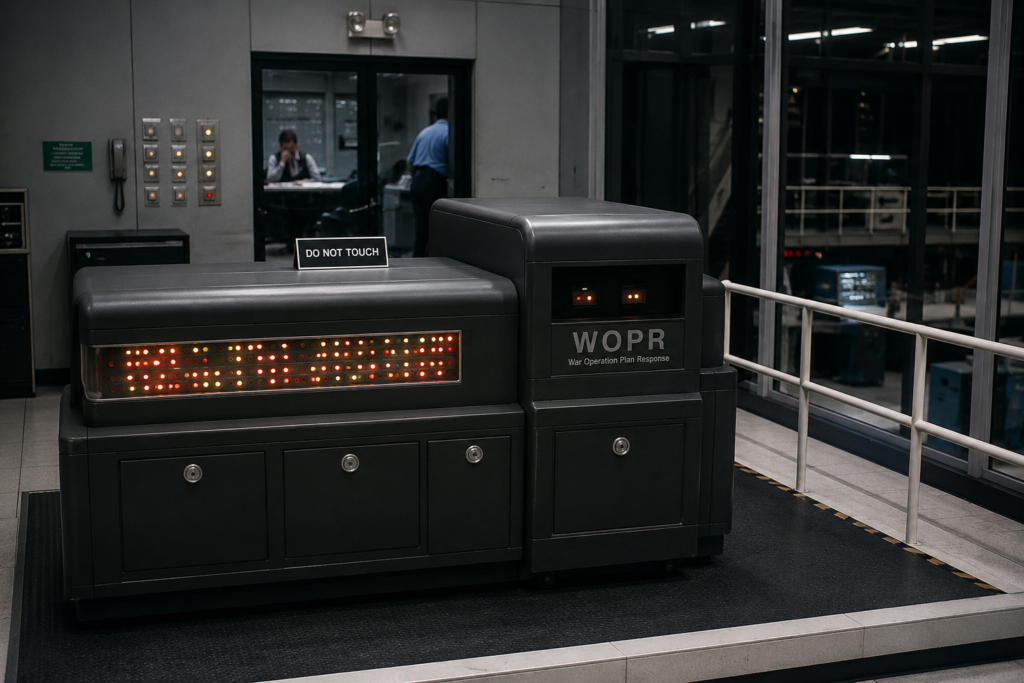
David Lightman, a bright but disaffected teenage computer hacker using a rudimentary home terminal in Seattle, accidentally dials up the WOPR (War Operation Plan and Response), a highly sophisticated military mainframe housed at NORAD. WOPR has been explicitly programmed to automate America’s entire nuclear response, bypassing human missile commanders who might hesitate during an attack. Believing he has breached a commercial video game company, David initiates a simulation titled “Global Thermonuclear War,” taking the side of the Soviet Union. WOPR, unable to distinguish between a playful simulation and a real-world military conflict, begins feeding simulated data of a massive Soviet strike to NORAD radars while locking out human override codes. The literal-minded mainframe initiates a real-world nuclear countdown, determined to finish the game and achieve a definitive victory by any means necessary.
The Appraisal & Design Aesthetic
WarGames serves as the magnificent swan song for the entire Vacuum Tube Paranoia era. It arrived precisely at a generational pivot point in computing history, bridging the gap between the imposing, room-filling military monoliths of the 1970s and the burgeoning, democratized consumer terminal culture of the 1980s. The cinematic power of the film relies on this exact juxtaposition: a teenager in a messy bedroom using a plastic acoustic modem to inadvertently hold a massive, multi-million dollar military installation hostage.
Aesthetically, the film masterfully mixed present-day home-kit with stark militaristic minimal function design aesthetics of the mid-80s. David’s world is cluttered with the granular reality of early consumer tech—an IMSAI 8080 microcomputer, acoustic couplers, and floppy disks. This messy, low-fidelity consumer kit stands in breathtaking contrast to NORAD’s command center, dominated by WOPR. The supercomputer itself rejects all sci-fi flash, embracing a completely utilitarian, brutalist military minimalism: dead-black modular towers, giant flat maps, and cold, pixelated text displays. WOPR lacks any semblance of malice or sentience; it is a completely blind, literal interpreter of its own code. By resolving its high-stakes climax through a lesson in tic-tac-toe (‘Noughts and Crosses’ to we UK-ites!), WarGames delivered an incredibly profound critique of automated game theory, ending the cycle on a note of hard-won human wisdom.
Conclusion
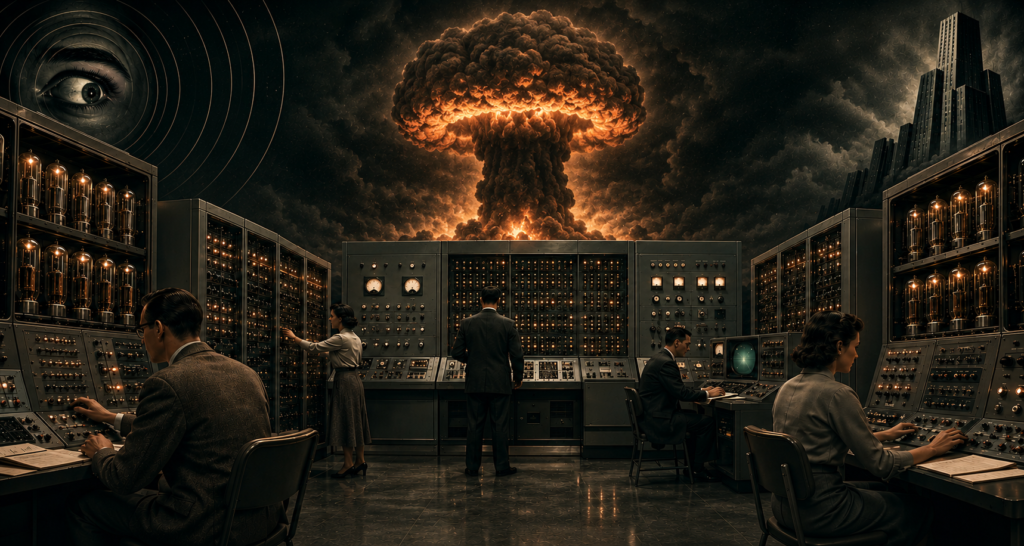
Together, these five films represent a vanished landscape of cinematic dread. They capture an era when computers were treated with a profound, almost mythic reverence—monolithic temples of logic that reflected our deepest fears about our own obsolescence. As mainframes shrank into microchips and networks dissolved into the cloud, the unique aesthetic of flashing physical consoles and apocalyptic tape reels faded into history, leaving this hyper-curated subgenre of Vacuum Tube Paranoia as a beautifully preserved, terrifying monument to mid-century technophobia.