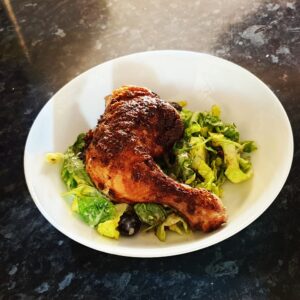
Parthian Chicken: A recipe so good, the Romans invaded an empire to get it!

Ancient Roman cuisine offers a fascinating glimpse into the culinary traditions of one of history’s most influential civilizations. Among the array of dishes passed down through the centuries, one recipe stands out for its unique blend of flavors and historical significance: Parthian Chicken. This dish, a favorite in Roman households, showcases the Romans’ love for bold spices and their willingness to incorporate elements from the far reaches of their empire.

In this blog post, we’ll explore the origins of Parthian Chicken, its ingredients, cooking methods, and what it tells us about Roman culinary culture. We’ll also provide a detailed recipe so you can recreate this ancient dish in your own kitchen.

The Origins of Parthian Chicken

A Taste of the East in Rome

The name “Parthian Chicken” suggests a connection to the Parthian Empire, a major political and cultural power that rivaled Rome in the east. The Parthians were known for their skilled cavalry and archery, but they also had a rich culinary tradition. As Rome expanded its influence and engaged in trade with the Parthians, culinary exchanges naturally occurred.

The Roman fascination with exotic flavors from the east is well-documented. The spice trade was a significant aspect of this cultural exchange, with ingredients like pepper, cumin, and asafoetida (known as silphium in Rome) making their way into Roman kitchens. Parthian Chicken, with its distinctive blend of eastern spices, is a perfect example of how Roman cuisine was shaped by these interactions.

Apicius: The Source of Parthian Chicken

Our knowledge of Parthian Chicken comes from the ancient Roman cookbook De Re Coquinaria, attributed to a gourmand named Apicius. While the true identity of Apicius is a subject of debate, the recipes in this collection offer a detailed look at the culinary practices of upper-class Romans.

Parthian Chicken is one of the many recipes in Apicius that highlight the use of spices and herbs. The dish combines flavors that were both familiar and exotic to Roman palates, creating a meal that was likely considered both luxurious and sophisticated.

Ingredients of Parthian Chicken

A Blend of the Familiar and the Exotic

Parthian Chicken is characterized by its use of spices that were not native to Rome but were imported from the east. The key ingredients include:

  • Chicken: As the name suggests, chicken is the primary protein in this dish. Romans consumed various types of poultry, but chicken was particularly popular due to its versatility and relatively easy preparation.
  • Pepper: Black pepper was a highly prized spice in ancient Rome. Imported from India, it was used in a variety of dishes to add heat and depth of flavor.
  • Cumin: Another spice with eastern origins, cumin adds a warm, earthy flavor to the dish. It was commonly used in both savory and sweet Roman recipes.
  • Asafoetida: Known as silphium in Rome, this pungent resin was a staple in Roman cooking. It has a strong, garlicky flavor and was used as a substitute for garlic and onions, which were considered peasant food. In some countries, Asafoetida is known as ‘Yellow Hing Powder’.
  • Wine: Roman cooking often involved the use of wine, both as a beverage and a cooking ingredient. In Parthian Chicken, wine is used to deglaze the pan and create a rich sauce.
  • Vinegar: Vinegar was frequently used in Roman cuisine to add acidity and balance to dishes. In this recipe, it contributes to the tangy flavor of the sauce.
  • Fish Sauce (Garum): Garum was a ubiquitous condiment in Roman cooking, made from fermented fish. It adds a salty, umami flavor to Parthian Chicken, similar to the role of soy sauce in modern cuisine.
  • Coriander and Rue: These herbs were commonly used in Roman cooking. Coriander adds a citrusy note, while rue has a slightly bitter taste that complements the richness of the dish.

Sourcing Ancient Ingredients Today

While some of the ingredients in Parthian Chicken are easily accessible today, others, like asafoetida, may be less familiar. Asafoetida is available in specialty spice shops or online and can be a fascinating addition to your spice cabinet. If you can’t find garum, fish sauce is a suitable substitute, although the flavor profile may differ slightly.

The Cooking Method

A Glimpse into Roman Kitchens

The cooking methods used in ancient Rome were often dictated by the tools and resources available. Romans typically cooked over open fires or in clay ovens, using pots and pans made from clay, bronze, or iron.

Parthian Chicken is a relatively straightforward dish to prepare, but it requires attention to the balance of flavors. The chicken is first browned to develop a rich, golden color, and then it is simmered in a sauce made from wine, vinegar, and spices. This method ensures that the chicken remains tender and absorbs the complex flavors of the sauce.

Modern Adaptations

While the original recipe likely involved cooking over an open flame, modern kitchens allow us to recreate this dish with more convenience. A stovetop and oven work perfectly for this recipe, and you can use a heavy-bottomed skillet or Dutch oven to achieve the best results.

Parthian Chicken Recipe

Now that we’ve explored the history and ingredients of Parthian Chicken, let’s dive into the recipe itself. This version is adapted for modern kitchens but stays true to the spirit of the original Roman dish.

Ingredients

  • 1 whole chicken, cut into pieces (about 3-4 pounds)
  • 2 tablespoons olive oil
  • 1 teaspoon black pepper, freshly ground
  • 1 teaspoon cumin seeds
  • 1/2 teaspoon asafoetida (optional, or use garlic as a substitute)
  • 4 fl oz dry white wine
  • 2 fl oz red wine vinegar
  • 2 tablespoons fish sauce (garum or substitute with modern fish sauce)
  • 1 teaspoon ground coriander
  • 1/2 teaspoon dried rue (or substitute with a small amount of rosemary or thyme)
  • Salt to taste
  • Fresh herbs for garnish (parsley or cilantro)

Instructions

  1. Prepare the Chicken: Begin by cutting the chicken into pieces. Season the chicken with salt and set aside.
  2. Heat the Olive Oil: In a large skillet or Dutch oven, heat the olive oil over medium-high heat. Once the oil is hot, add the chicken pieces, skin side down, and cook until they are browned on all sides. This should take about 8-10 minutes. Remove the chicken from the pan and set aside.
  3. Toast the Spices: In the same pan, add the cumin seeds, black pepper, and asafoetida (if using). Toast the spices for about 1-2 minutes, until they become fragrant. Be careful not to burn them.
  4. Deglaze the Pan: Add the white wine to the pan to deglaze it, scraping up any browned bits from the bottom. This will add depth of flavor to the sauce. Allow the wine to simmer for 2-3 minutes.
  5. Add Vinegar and Fish Sauce: Stir in the red wine vinegar and fish sauce, then add the ground coriander and dried rue. Mix well to combine the flavors.
  6. Return the Chicken to the Pan: Place the browned chicken pieces back into the pan, ensuring they are coated with the sauce. Reduce the heat to low, cover the pan, and let the chicken simmer gently for about 30-40 minutes, until it is fully cooked and tender.
  7. Adjust Seasoning: Taste the sauce and adjust the seasoning if necessary. You may want to add a bit more salt or pepper, depending on your preference.
  8. Serve: Transfer the chicken to a serving platter, spooning the sauce over the top. Garnish with fresh herbs like parsley or cilantro for a burst of color and freshness.
  9. Accompaniments: Parthian Chicken pairs well with a variety of side dishes. Consider serving it with spelt or barley bread, which were common grains in ancient Rome, or with modern sides like roasted vegetables or a fresh salad.
  10. Drink: Try a goblet of red wine or mulsum.

Tips for the Modern Cook

  • Balancing Flavors: The key to a successful Parthian Chicken is balancing the strong flavors of the spices and the acidity of the vinegar with the richness of the chicken. Taste as you go and adjust according to your palate.
  • Substitutions: If you can’t find certain ingredients like asafoetida or rue, don’t worry! Garlic and common herbs like rosemary or thyme can be used as substitutes without drastically altering the character of the dish.
  • Experiment with Spices: The Romans were known for their experimental approach to cooking. Feel free to play around with the spice levels to suit your tastes. You might try adding a pinch of cinnamon or nutmeg for a slightly different twist.

Mulsum

Mulsum is a traditional Roman drink made by mixing wine with honey, and sometimes spiced with herbs or spices. It’s a sweet, refreshing beverage that was often served as an aperitif. Here’s a simple recipe for making Mulsum at home:

Quick Mulsum Recipe

Ingredients:

  • 1 bottle of red or white wine (750 ml)
  • 4 fl oz honey (adjust to taste)
  • 1 cinnamon stick (optional)
  • 2-3 cloves (optional)
  • 1-2 strips of orange or lemon peel (optional)

Instructions:

  1. Warm the Wine and Honey: In a saucepan, combine the wine and honey. Heat gently over low to medium heat, stirring until the honey is fully dissolved. Do not bring to a boil.
  2. Add Spices (Optional): If using, add the cinnamon stick, cloves, and citrus peel to the mixture. Continue to heat for 5-10 minutes, allowing the flavors to infuse.
  3. Cool and Serve: Remove the saucepan from heat and let the Mulsum cool to room temperature. Strain out the spices and peel if used. Transfer the Mulsum to a pitcher or bottle and chill in the refrigerator.
  4. Serve: Serve chilled, either as an aperitif before a meal or as a refreshing drink on a warm day.

Enjoy your homemade Mulsum! It’s a simple yet flavorful way to experience a taste of ancient Rome.

The Cultural Significance of Parthian Chicken

What This Dish Tells Us About Roman Society

Parthian Chicken is more than just a recipe; it is a window into the cultural and social dynamics of ancient Rome. The use of exotic spices and ingredients reflects the wealth and cosmopolitan nature of Roman society, particularly among the upper classes. This dish was likely served at lavish banquets, where hosts would impress their guests with the finest foods and wines.

The blending of eastern and western culinary traditions in Parthian Chicken also speaks to the interconnectedness of the ancient world. Rome’s expansive trade networks and military conquests brought new flavors and ideas to the empire, enriching its culinary landscape.

The Role of Food in Roman Identity

Food was an essential part of Roman identity, serving not only as sustenance but also as a marker of social status and cultural sophistication. Dishes like Parthian Chicken exemplified the Roman desire to incorporate and master foreign elements, a reflection of their broader imperial ambitions.

Moreover, the Roman approach to cooking was deeply communal, with meals often being shared experiences that reinforced social bonds and hierarchies. Preparing and enjoying Parthian Chicken today can offer a taste of this communal spirit, bringing people together over a dish that has been enjoyed for millennia.

Conclusion

Parthian Chicken is a remarkable example of how ancient recipes can still captivate modern palates. Its rich history, combined with its bold and complex flavors, makes it a dish worth exploring for anyone interested in culinary history or simply looking for something new to try in the kitchen.

By recreating Parthian Chicken, you’re not just cooking a meal—you’re participating in a tradition that dates back thousands of years, connecting with the tastes and traditions of the ancient Romans. Whether you’re a history enthusiast, a foodie, or just someone who loves trying new recipes, Parthian Chicken is sure to offer a unique and memorable culinary experience.

So why not take a step back in time and enjoy a taste of ancient Rome tonight? Happy cooking!

Garum – The Roman Ketchup : Part 2 – Testing Heinrich Wunderlich’s Recipe

Heinrich Wunderlich, on his German page:  Garum oder Liquamen der Alten, provides a method by which the industrial method of garum production can be reduced to quantities which can be produced in the culina, in sealed jars.

Kilner jar after shaking

Fresh sprats being available, I decided to replicate the recipe and see how well it worked. Equipped with a Kilner jar, sprats and salt, I set to.

I purchased 2lb of sprats, 1lb of which was for the experiment and 1lb for cooking a paella.

Since the sprats for the paella did not require the offal, I gutted them and added them to the salted sprats which were lined whole in the Kilner jar in alternating layers of sprat/offal and salt.

Produced salt liquid, submerging half
of the fish after three hours.

Once the Kilner jar was full, the lid was sealed and shaken to ensure that the salt was evenly covering everything in the jar.

The jar was left to stand (there being a heatwave at the time) and observed at regular intervals).

What was immediately noticeable was that the salt was instantly causing the liquids within the sprats to seep out of the fish, resulting in the rapid submerging of the fish in a salt liquid.

Produced salt liquid submerging all of
the sprats after 12 hours

Within three hours, the liquid was filling half of the depth of the Kilner jar. Within 12 hours, the liquid had filled the jar.

In preparation for reproducing this process, a few months ago, I purchase a yoghurt incubator, but I need to perform a little manipulation of the Kilner spring in order to make it fit.

Within five hours of placing the Kilner jar into the incubator, the liquid had expanded and the internal pressure was causing it to seep out past the rubber seal, resulting in a crystalisation of the salt on the outside of the jar. In order to stop this, I hastily sterilised an old olive jar and transferred the floculence into it.

Unfortunately the lid of the incubator will not fit on, thanks to the size of the olive jar, but I hope that this doesn’t result in too much heat loss from the incubator.

Floculence transferred
to olive jar
Olive jar in incubator

Results

Floculence after 15
days

After fifteen days, the garum was beginning to separate from the floculence. What was surprising about this was that the garum was appearing at the bottom of the container, not the top.

This seems at odds with the description that a fine woven basket was pushed into the top in order to extract the garum.

Garum at the bottom of the jar
after 20 days.

After 20 days the garum at the bottom of the jar was quite clear. There was a deposit on the bottom of the jar of material which was obviously denser than the garum, while the floculence itself was less dense than the garum and remained floating above it.

There was no significant observational change between day 20 and day 30.

Liquid draining into bowl

On day 30, the contents of the jar were poured into a fine sieve so that the liquid would drain into a bowl. A towel was placed over the bowl and sieve to ensure against airborne contaminants. The whole sieving process required five hours.

The resultant liquid contained particulates, making the garum cloudy. Is it possible that the liquid in this state, constituted ‘garum’ while the clarified liquid was ‘liquamen’? There may be something in this, considering that the ‘mock garum’ recipe, which was made from alec, would undoubtedly be cloudy.

Right: liquid after sieving. 
Left: liquid after filtering.

In any case, I decided to filter the liquid. Using the cut up top of a 250ml mineral water bottle and a paper kitchen towel (I was unable to get filter paper quickly since my homebrew shop has moved over to the next town), I started filtering the liquid into a sterilised bottle.

Alec after all of the liquid was drained

The alec was placed into a plastic container and frozen, to keep for the next experiment, which will be making mock-garum.

The final product: ⅓ pint of garum

Coming next…

Making ‘Mock-Garum’

Reconstructing an industrial process

Creating a miniature garum tank

Experiment 2: Recreating the process on a small scale

Garum – The Roman Ketchup : Part 1 – The Evidence

An army may have, as Frederick the Great intimated, “marched on its stomach”, but that didn’t necessarily mean that they liked what they ate. When a plebeian joined up with the intention of becoming a citizen and marched across the empire during his four years of service, he had to pay for everything, including his own uniform, all except for one thing…

A small phial which was issued to every soldier and its contents were topped up once a month without cost. This phial was secured to the soldier’s belt with a leather thong and contained the most important thing known to him, a condiment called ‘Garum’.

For food, the army could live off the land and the local cuisine, but to render it palatable, the soldier would smother the ‘weird foreign flavours’ with Garum… and you thought that smothering local cuisine with ketchup was a uniquely British trait – we got it from the Romans!

Garum is a fermented sauce which was prepared from the blood and intestines of fish through a reaction called autolysis. Autolysis is a process of self-digestion, whereby the cells of an organism are dissolved by the digestive fluids that they produce. Other decomposition processes are hindered in the manufacture of garum through salting the fish. The combination of salt and the enzymes of digestion produce a unique reaction however, the result of which is a high concentration in the product of monosodium glutamate.

Monosodium glutamate (MSG) is used in the food industry as a flavour enhancer, it doesn’t alter the flavour itself, but increases the intensity of the signals from the taste buds in the same way  turning up sound volume amplifies the sensation but doesn’t change the sound. While other flavour complexes provide the taste experience, the MSG amplifies the sensation, resulting in a condiment which can effectively smother any unwanted flavour and, as an additive to any recipe, is a natural flavour enhancer.

According to Alexis Soyer’s ‘Pantropheon’ (printed in 1853), the word Garum came from the classical Greek garos, meaning shrimp, indicating that garum was originally made from this crustacean. There appears to be no confirmation of this in classical Greek however and I have certainly not found this as a word for shrimp in any of the lexicons that I possess. The general consensus is that garos (γάρον) was classical Greek for a fish, the identity of which, no one has yet managed to ascertain.

There is another possibility…


A work on farming, called Geoponika was produced in the 10th century and although the book post-dates the fall of Rome by 500 years, it summarises a wealth of information from earlier sources which date back to the time of the Roman empire. The 46th chapter of the 20th volume is dedicated entirely to the production of garum. Since the book is 1000 years old, and the translation that I have used (not being able to get the original Latin text) was published in 1805, both are out of copyright and so I will quote the chapter in its entirety:


Geoponika Liber XX:XLVI – The Composition of Garum
What is called Liquamen is thus made: The intestines of fish are thrown into a vessel, and are salted; and small fish, especially atherinæ, or small mullets or mænæ, or lycostomi, or any small fish, are salted in the same manner; and they are seasoned in the sun, and frequently turned; and when they have been seasoned in the heat, the garum is thus taken from them. A small basket of close mixture is laid in a vessel filled with the small fish already mentioned, and the garum will flow into the basket; and they take up what has been percolated through the basket, which is called Liquamen; and the remainder of the floculence is made into alec. But the Bythinians prepare it in this manner: they indeed take small, or large mænæ, which are more eligible; but if they cannot get them, lycostomi or sauri, or scombri, or alec, and a mixture of all; and they throw them into a baking trough, in which they have been used to mix their meal; and having applied two Italian sextarii of salt to a modius of fish, they work them, that they may be mixed with the salt; and having suffered them to lie during one night, they put them into an earthen vessel; and they set this in the sun during two or three months, stirring them with a stick at stated periods; they then take and stop them and lay them by. Some indeed pour two sextarii of old wine on a sextarius of fish. But if you wish to use the garum immediately, that is not to insolate it, but boil it, you are to do it in this manner: take some strong brine that is proved, so that an egg being put into it may swim (but if it sinks, it has not a sufficient quantity of salt); then throw the fish into the brine in a new pot, and adding some origanum, set it over a good fire, until it boils, that is, until it begins to be a little diminished (some also add sapa to it); then when it is cool, pour it into a strainer a second and a third time, until it comes out clear; and having stopped it, lay it by. But the best garum, which is called Aimation, is thus made: the intestines of the tunny, with the gills and the ichor, and the blood, are taken, and they are sprinkled with a sufficient quantity of salt; and they are left in the vessel during two months in general; the vessel being tapped, the garum called aimation is drawn.


What we can see from this chapter is that there are several fish from which garum is made:


Atherinæ = Mediterranean Sand Smelt
Mullet
Mænæ = Anchovy
Lycostomi = Sprat
Sauri = Infant Mackerel
Scombri = European Pilchard
The guts, gills and ichor of Tunny = Tuna
and as it says, ‘or any small fish’.
The similarity between all of these fish as that they are small, either small fish or infant fish, typically between 25mm and 50mm long, what we would term today as whitebait or fry. Generally, the young of many different species of fish tend to gather together into shoals for protection, from where they can be caught using fine meshed nets. The whole of the fish, caught as fry is edible, including the head, fins, bones and guts and since the fish is not fully formed, any autolysis process would dissolve the organism entirely to a liquid. Whereas of larger fish, only the guts, ichor and gills are used in garum production. It is consequently a possibility that the term garos is classical Greek, not for an unidentified species of fish, but for the fry of many species.This seems to be confirmed by the distribution of garum factory sites across the Mediterranean, and their processing capacities, which coincide with the migratory routes of such shoals, with an especially increased presence between Valencia, the straits of Gibraltar and round the Spanish coast to the Bay of Douarnenez in Brittany, where particularly large shoals are known to swim. Indeed according to Strabo, the most renowned and highest quality garum that was imported into Rome, was known as garum sociorum (garum of the allies) and came from the factories of Cartegena in southern Spain, which was directly located on a large migratory shoal route.
It appears that the manufacture of garum was exclusively an industrial process, as generally described above, but there was also a ‘mock-garum’ which could be made in very little time, in the culina. This was called muriæ and we can assume that the cooked garum recipe also given in the Geoponika is a form of muriæ. The main difference between garum and mock-garum is that there is no process of autolysis in the making of muriæ and as a consequence, the production of MSG is minimal. As a consequence, although muriæ may possess the flavour of garum, it does not provide the flavour-enhancement that appears to be the addictive component of it.


There were several different qualities of Garum but it is not known what the variations were between them. Some have postulated, and it is quite probable, that the differences were based on the exclusivity of the source fish, for example Apicius considered that the most refined garum was to be made from the Red Mullet (Mullus surmelutes), but this consideration was probably made based on the rarity of the fish and its concomitant cost; one existing document gives the cost of one Red Mullet as 60 sestercii (15 denarii), whereas a Mackerel would cost one semis, or in other words you could get 32 Mackerel for 1 denarii. This probably indicates more to us about the gourmet Apicius’s’ snobbery than the composition of Garum; having dined his way through a personal fortune of 100 million sestercii and finding that he had a mere 10 million sestercii left and afraid of dying in poverty, he took his own life. Juvenal stated in his writings that he could live quite happily on the income he could generate from 400,000 sestercii.
Liquamen is sometimes described as being different from garum, and sometimes as the same. From reading the Geoponika, it seems that a sauce which has been strained into a clear liquid is liquamen, the solid residue of which is alec whereas a sauce which has not been strained, is garum.


It is also most likely that the lowest quality ordinary garum was made from whatever fish by-products were available and it is most likely to have been this quality which was issued as the free ration to the army; if they used it up too quickly, then they had to purchase their own top-up and garum was usually available at every vicus along a Roman road.

The qualities in between are anyone’s guess although Geoponika states that the best garum is aimation.


The principal factor in the making of garum is autolysis, however there are other factors that have a bearing on its production. To understand these factors, it is important to examine all of the available evidence. The most prolific of which is not the literary descriptions of the product but the findings from the archæological excavations of the numerous garum factories around the Roman world.

Evidence indicates that the garum factories used concrete basins of decreasing sizes, which indicate a process of reducing volume. It can be assumed that the larger vessels take the newer product and that during autolysis, there is a reduction in volume as the material becomes more concentrated. When this reduction is achieved, the floculence is transferred into the next vessel (in order for the first to be refilled with the next batch) and again and again until the material ends up in the smallest vat, from where the liquor is drawn off from the alec.

On his page Garum oder Liquamen der Alten, Heinrich Wunderlich demonstrates the manufacture of garum using a yoghurt maker and jam-jars, but this may not produce an accurate garum since the concentrating of the liquid through evaporation would not be occurring in the sealed containers.

According to Athena Trakadas’s article ‘The Evidence for Fish Processing in the Western Mediterranean’, garum factories were roofed over in order to prevent rapid evaporation from direct sunlight, which also eliminates ultra violet light as a factor in the process. On the other hand, Trakadas indicates that workshops were either open at the sides (very similar to monastic cloisters) or had windows which allowed significant ventilation. This appears to be a consistent feature of all garum workshops excavated. It can be concluded therefore that the action of breezes, assisted the process of evaporation and is a significant part of the garum making process.

The presence of a hypocaust is also noted, which was used to ensure an even vat temperature. An 83mcistern which was constructed beneath the workshop, must also be considered as part of the process.

The quantity and shapes of the the garum making vats remains consistent across most of the workshops that have been excavated. Take for example the vats in the workshop at Cotta in Tangiers: There are two large vats (nos 1 & 12), four smaller vats which are ranged next to each of the large vats; 2 – 5 for large vat 1 and 13 – 16 for large vat 12. There are then four even smaller, vats next to large vat 1 (6 – 9) and two smaller vats which are next to large vat 12 (10 & 11).

What is interesting is that in each case, the vats maintain specific proportions in terms of the surface area of the liquid. Vats 2 – 5 & 13 – 16 have a surface area which is roughly ⅔ the surface area of vats 1 & 12, while vats 6 – 9 have a surface area which is roughly ¼ the surface area of vat 1. Vat 10 is roughly ⅓ the surface area of vat 12, while vat 11 is roughly ⅔ the surface area of vats 13 – 16.

This pattern is repeated through most of the excavated workshops, which indicates that the garum makers were controlling the speed at which the floculence was concentrating, by regulating the evaporation rate of liquid from the vats.

It is fairly easy to calculate average evaporation rates, providing you have some specific meteorolgical data for the locality such as the average temperature, the average relative humidity and the mean dew point. To save space here, I will post the calculations I have used in a separate blog.

Tanks 1 & 12 are 3.5m x 3.5m, giving an evaporation area of 12.25m2 and an evaporation rate of 358.707 litres per day

On the other hand, tanks 6 – 9 are 1.2m x 1.2m, giving an evaporation area of 1.44m2 and an evaporation rate of 42.166 litres per day.

Therefore it can be postulated that decanting between tanks was necessary because regulating the speed of evaporation at different stages was an essential part of the process.

The problem that we still have is working out the process. We can be fairly sure that the layout of all the excavated workshops indicated that each tank was related to its neighbour in terms of process-flow. And, in addition to this, we can also assume that the large vats would be used in starting the process. We can therefore assume that there were two batch processes starting simultaneously in vats 1 & 12 and that once the first process was complete, the contents were decanted into their adjacent vats (2-5 & 13-16).

Vat Length (m) Width (m) Depth (m) Capacity (litres) Evaporation Area (m2) Evaporation Rate (litres/day)
1 & 12 3.5 3.5 2 24,500 12.25 358.707
2-5 & 13-16 3.5 2.6 2 18,200 9.1 266.468
6-9 1.2 1.2 2 2,880 1.44 42.166
10 3.5 1.75 2 12,250 6.125 179.353
11 3.5 1.3 2 9,100 4.55 133.234

Vats 2-5 & 13-16 have a capacity of 18,200 litres (25% that of the larger vats).

With an evaporation rate of 358.707 litres per day, it would require 18 days for the content of vat 1 to reduce sufficiently to be able to be decanted into one of the secondary vats (2-5).

Since two of the secondary vats would exceed the capacity of the primary vat, we can be sure that the primary vat was not decanted into two of the smaller vats, therefore we have to conclude that each primary vat batch was rendered down to the capacity of one secondary vat. Consequently the first ferment would require approximately 18 days to complete.

It is also fairly certain that if vats 6-9 related to the secondary vats 2-5, they would be in their proximity. Instead, they are ranged along another wall between vat 1 and vat 12, so it would seem probable that they were filled directly from vat 1, rather than as part of a tertiary process from vats 2-5.

The total capacity of vats 6-9 is 11,520 litres (2880 litres each) and it would take 24 days for vat 1 to render down sufficiently to fit into them.

We can assume then that vat 1 sequentially fed vats 2-5 and 6-9 over a period of 94 days, comprising of four 18 day ferments and one 24 day ferment.

We can assume that whatever happened in vats 2-6, the process was in excess of 54 days, otherwise there wouldn’t be a requirement for four secondary vats. At an evaporation rate of 266.468 litres per day from the surface area of these vats, 54 days would constitute 14,389 litres of liquid evaporated off (80% of the capacity), which would be unfeasible considering the quantity of solids which would be present in the tank. It is likely therefore that as part of the secondary process, the vats received a regular top-up from the 86,000 litre cistern which was constructed beneath the workshop.

It is also probable therefore that the output of the secondary tanks constituted the workshop’s output of ordinary garum; 116,480 litres (allowing for a 20% reduction in capacity per tank during the secondary process). This would constitute  213,333 sextarii in Roman measurements, which according to Diocletian’s “Edict of Maximum Prices” issued in 301 AD, which specified that a sextarius of ordinary garum cost 12 sestercii (3 denarii), means that over a 94 day period (¼ of a year) the income for the workshop was 640,000 sestercii.

It is probable that tanks 6 -11 were used for the processing of smaller quantities of specialist sauces, such as hydrogarum, œnogarum, oxygarum etc..

Tradakas’s article mentions that in the Cotta complex:

“An olive press was also installed in the building, probably producing olive oil for consumption by the workers of the site.”

Although it is likely that this was used for consumption by the workers, other uses cannot be ruled out, such as use of the oil for lighting and as a component of the garum production.

Many books and websites tend to categorically state that the smell of garum production was so awful that the factories were banished from within city walls. There is neither archaeological nor literary evidence for this.

Rather, the reason that garum factories were sited away from cities was that they were required to be as close to their source material as possible. As martial stated:

Take this costly gift, the proud gift
That’s made from the first blood
Of a still breathing Mackerel

— Martial : Book 13, Epigram 102

The fish had to be alive when it was thrown into the garum vat and salted. Although recent archaeological evidence has discovered that there was a small amount of garum making within the city of Pompeii, the factory which we know to have existed in the area has not yet been found. This is unsurprising when you examine the location of the city,

which is within the bay of Naples and hardly within easy access to a significant shoal migratory route. The garum of Pompeii was considered to be one of the best available, but it is entirely likely that the factory was a significant distance from the city. In all likelihood it will be sited near Sorrento, Positano or Amalfi.

Baelo Claudia

Tradakas’s article mentions that the Cotta complex possessed a watch-tower for sighting shoals in order to direct the fishing boats at sea towards the catch. All of the examined garum workshops possessed similar proximity to the shore.

The garum factory at Bælo Claudia is positioned directly between the town and the shore. With the wind most likely flowing from the sea and across the land, Bælo Claudia would be disadvantageously down-wind of the factory if the smell was as disgusting as is frequently described.

It is certain that the production of garum generated a smell, but for a society that was used to digesting the product of the process, it is unlikely that they would have been so hostile to the smell of the factory. Indeed, when you are acclimatised to a smell for long enough, you cease to notice it.

Vat Evaporation Calculations

Coming next…

Experiment 1: Testing Heinrich Wunderlich’s process